
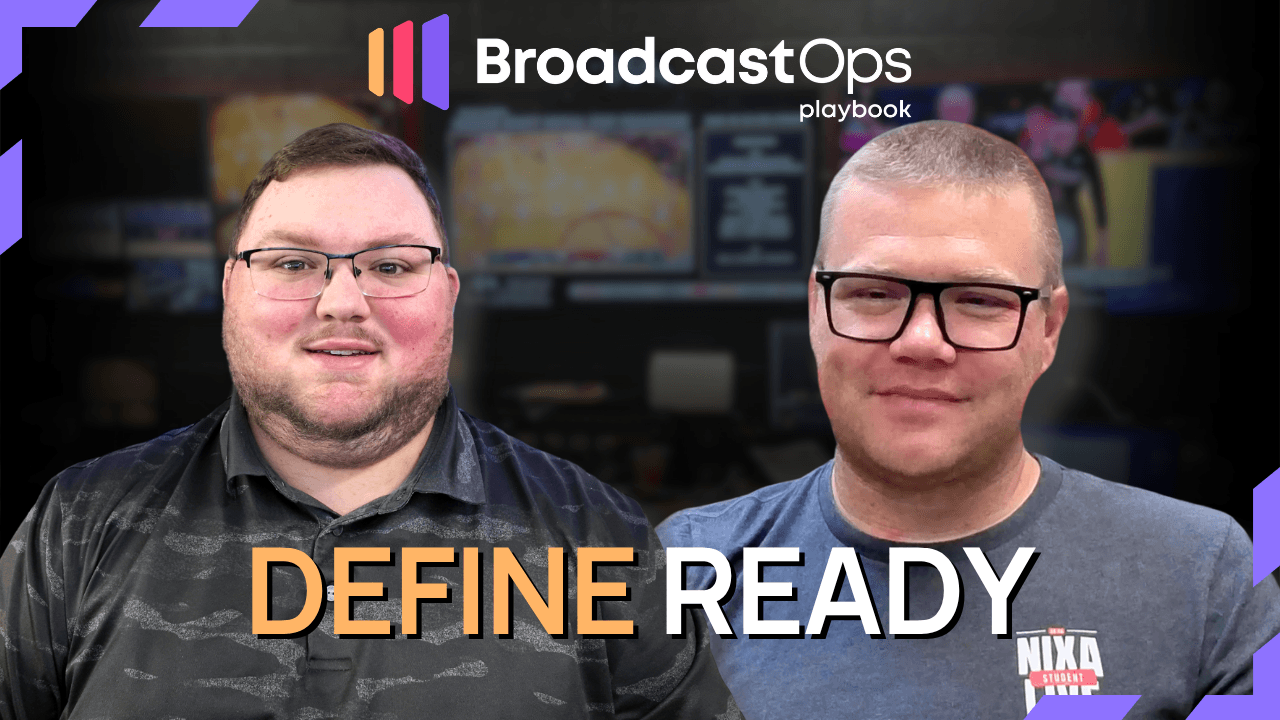
Every program you trust, you trust for a reason. Somebody showed you the receipts before they showed you the advice.
Season 2 of the Broadcast Ops Playbook opens with exactly that. Before Nathan Ladehoff and Jordan Burns hand you another system this season, they're showing you where their own programs came from, growing pains included.
Where to watch or listen
Spotify: https://open.spotify.com/show/5SZYjaQtD6npuuExlOBrDB?si=4ea4a6d1167a4303
Apple Podcasts: https://podcasts.apple.com/us/podcast/broadcast-ops-playbook/id1866687202
YouTube: https://youtu.be/yLPtsanh54M
Where Nixa LIVE Started
Jordan Burns didn't start as the teacher running Nixa LIVE. He started as a volunteer with a single camera and no announcers, back when the broadcast was one person moving a camera back and forth. A scoreboard graphic meant a Photoshop file someone typed into by hand. The clock didn't run itself, a student updated it manually, one second at a time.
The program became an official club in 2019. Six students. By basketball season that same year, it was twelve.
The first seated class came in 2020, sixteen students, in the middle of COVID. From there it kept growing: a second camera, a student announcer alongside the adult one, a second class section by 2023, a virtual section by 2024. This fall, Jordan is running two seated classes and one virtual class, about 65 students total, covering roughly 165 games a year, up from around 30 when he started.
Growing Without Burning Out
Jordan is upfront about what that growth cost. "I pushed the boundaries a little harder than I wish I would have," he says. "I ran into a lot of roadblocks and issues along the way because of that."
That honesty is the spine of the episode. Nathan's reframe: "You can get somewhere by yourself fast, or you can get somewhere together far, and have it last longer." Programs that jump from zero to a hundred in year one tend to burn out the teacher and the students within a couple of seasons. The ones built in steady stages last. Jordan's in year twelve.
This Season's Rallying Cry: Define Ready
Every season, Jordan's program picks a theme. This year, two words: Define Ready.
Simple to say, harder to do. Build the SOPs and checklists now, so students know what "ready" looks like before a single game starts, instead of still fixing three things at kickoff. New students get a stair-step system instead of standing around waiting for instruction: try the role, ask the operator next to you, then a team lead, then the teacher, only if it's actually stuck.
Jordan's building this year's SOPs and checklists directly inside Broadcast Ops, so students can see what they're responsible for without him repeating himself before every broadcast.
Word of the Day: SOP
Standard Operating Procedure. What a program does on a routine basis, built so the outcome is repeatable because the inputs are the same every time. Nathan's take for teachers new to a program: you're actually in a good spot, you get to build these well from the start instead of untangling procedures that were never standard to begin with.
If you're a teacher running a broadcast or digital media program and it feels like you're figuring it out alone, Future Ready Educators is a free community built for exactly that. Join at futurereadyeducators.com.
The Broadcast Ops Playbook is a product of Striv Education.