

It's thirty minutes before tip-off. One student is texting "where do I go?" Another doesn't know which camera is theirs. Your scoreboard op is figuring out the software live. And you're running between all of it. Again.
After the broadcast you tell yourself the same thing every time: we just need more practice.
You don't. Practice isn't the problem. Preparation is. And those aren't the same thing.
Watch Episode 7
🎧 Prefer audio? Listen on Apple Podcasts or Spotify.
Game Day Doesn't Create Chaos. It Reveals It.
The chaos you feel on game day almost never starts on game day. It starts days before — in the gaps your pre-event process never filled.
Look at the symptoms. Students standing around when they arrive? That's a missing pre-event protocol. Last-minute scrambles for cables and dead batteries? That's a missing equipment check. The "where do I go?" text is at 5:45; you go live at 6:15? That's a missing call-time expectation.
The event doesn't create those gaps. The event just makes them impossible to ignore.
Why "We've Done This Before" Keeps Failing You
Most programs focus almost everything on what happens during the event. Almost nothing on what should happen before students arrive.
The unspoken assumption is: students who have done this before will figure it out. They've done this. They know.
But "we've done this before" isn't a system. It's an assumption. Assumptions break the second a student is new to a role, distracted, or hasn't thought about the broadcast since the last game three weeks ago.
So the teacher becomes the default answer to every pre-event question. The texts start an hour out. What time should I be there? Where's the equipment? What am I running tonight? You answer everyone — because there's nowhere else for the student to look.
This is not a motivation problem. It's a systems problem. There is a real difference between telling students when to show up and telling them what to have done before they arrive. Most programs only do the first one.
Jordan Burns at Nixa High School in Missouri lived this. Early on, he was fielding calls and texts in the hour before every single game. His students cared. They just didn't know what prepared looked like. Once he built pre-event checklists tied to specific roles, the texts stopped. Not because his students got better. Because the system got clearer.
The 4-Step Pre-Event Framework
If every game night feels like a scramble, the fix isn't more practice. It's a process students can actually follow before they walk in the door.
1. Define "Ready" for Each Role
"Ready" isn't a time. It's a checklist of completed tasks, specific to the role.
For a camera operator, that might be: battery charged, SD card formatted, shot list reviewed, position confirmed. Every role gets its own version. Every student knows what theirs is before they arrive.
Think of it like a pilot doing the pre-flight walk-around. Mechanics already checked the plane. The pilot still checks. Every time. No exceptions. Same expectation for students.
2. Give Call Time a Purpose
"Be here at 5:30" lands different than "Be here at 5:30 so you can complete your role checklist before warmups start."
When call time has a reason behind it, students take it seriously. When it's just a clock, they treat it like a clock.
3. Put a Student in Charge of Crew Check-In
A student leader — not the teacher — confirms crew arrival and checklist completion before the event.
If someone hasn't shown up by 5:45 and you go live at 6:15, the student leader escalates. You don't have to notice. The system catches it.
This is what we mean when we say the teacher should be the last resort, not the first responder. The system catches problems. Students escalate when needed. You coach — you don't manage.
4. Run a Post-Event Debrief
What went wrong. What took longer than expected. What question came up that shouldn't have. Those answers update the checklist.
The system improves because of the event, not just before it. Skip this step, and you'll keep solving the same problems forever.
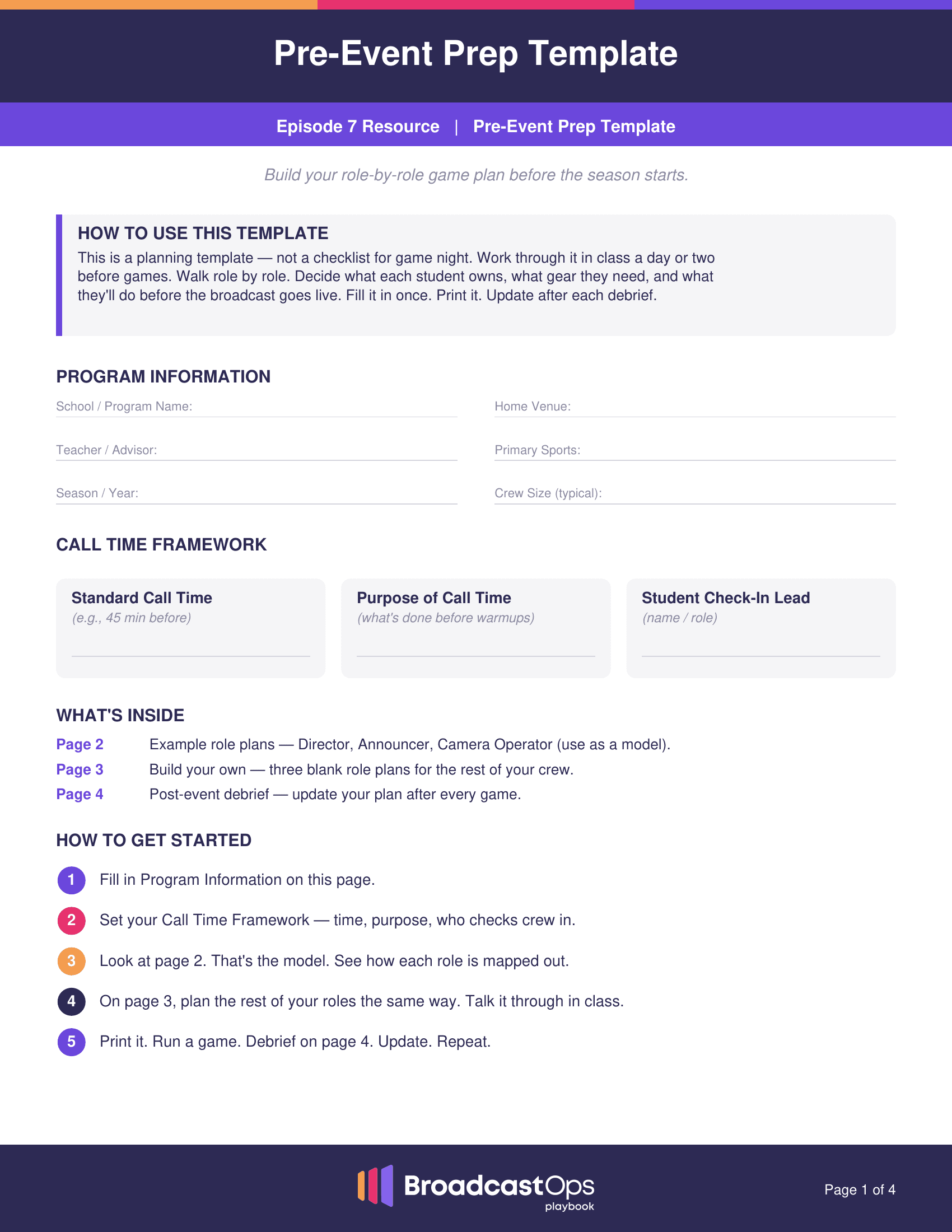
Free Resource: Pre-Event Prep Template
We're publishing this at the end of the school year on purpose. The best time to build your pre-event process isn't during fall season when you're already in it. It's right now. Over the summer.
So we put together a free Pre-Event Prep Template. It's a one-page fillable plan that walks you through building a pre-event checklist for each role in your program. Fill it in for your setup, your crew, your events. Show up to game one of next season with something your students can actually follow.
👉 Download the free Pre-Event Prep Template →
How Broadcast Ops Helps
Broadcast Ops is built around this exact pattern. Pre-event role checklists. Call-time expectations. Student-led check-in. Post-event reflection.
The point isn't features. The point is that the system exists outside of you. So your program doesn't stop when you're not in the room — and game day stops being the moment everything falls apart.
What's Next: SOPs That Outlast You
You've got a pre-event process that works. You ran it once. It went well. Then a key student graduates. Or a new student takes over a role. And suddenly you're explaining everything from scratch.
That's the next problem. Not how to build a process that works the first time. How to build one that works every time — without you re-teaching it every season.
That's Episode 8. Standard operating procedures. Why most programs skip them, what happens when they don't, and how to build something that outlasts you.
Related reading: Game Day Chaos Isn't a People Problem. It's a Systems Problem.
About Striv Education
Striv Education helps K-12 teachers build sustainable, student-led broadcast and media programs. Through Broadcast Ops software, the Future Ready Educators community, and the Broadcast Ops Playbook podcast, we give teachers the systems to get out of the weeds and let students own the work.