
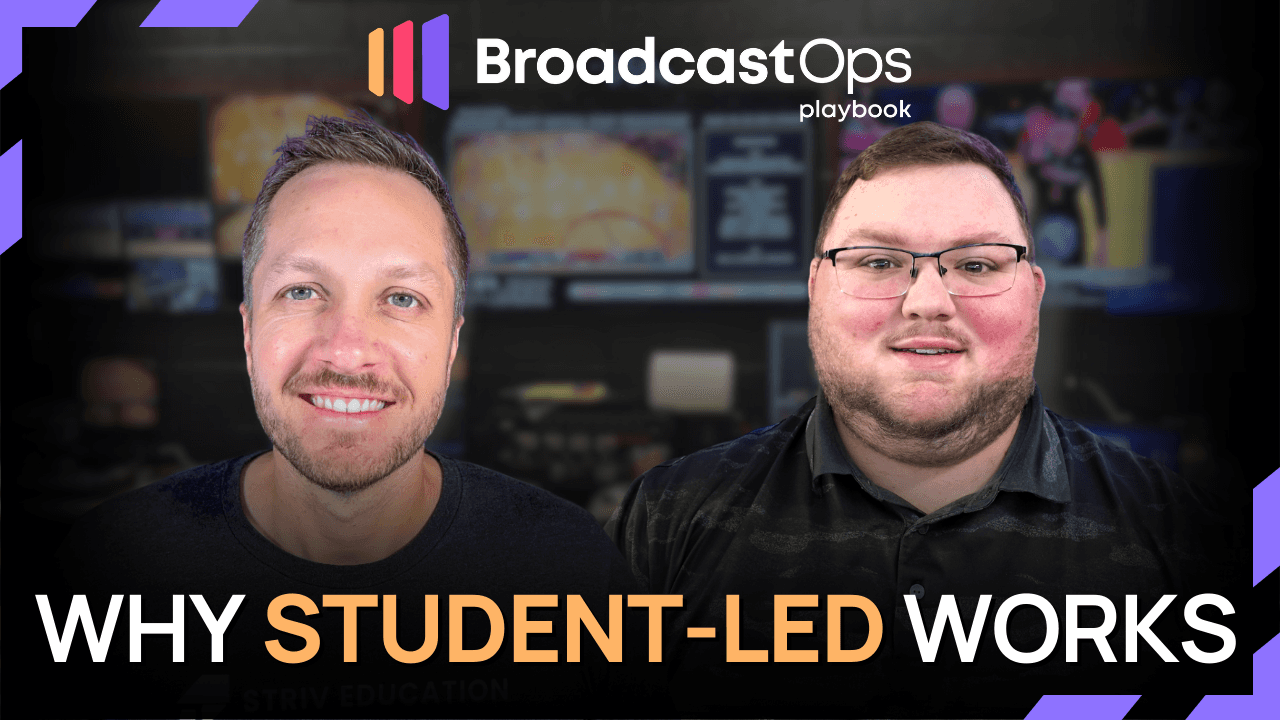
Starting a student-led broadcast program can feel overwhelming.
Not because teachers don’t care.
But because time is tight, expectations are high, and it’s hard to see how something new fits without adding more stress.
We see this pattern across schools all the time.
That’s why we launched a new podcast called Broadcast Ops Playbook—a show for teachers who want to build student-led broadcast and media programs without the chaos.
Episode 1 starts with a simple question many schools are quietly wrestling with:
Is a student-led broadcast program even worth starting?
The Real Hesitation Schools Face
When schools hesitate to start a broadcast program, it’s rarely about motivation or student interest.
It’s usually about:
time pressure
uncertainty around where to begin
concern about equipment and quality
Teachers don’t want to start something they can’t sustain.
That hesitation is valid.
Why Most Programs Feel Heavy at the Start
One of the biggest mistakes schools make is trying to scale before they have structure.
They focus on:
buying equipment
adding more roles
trying to make everything look polished
But without clear systems in place, the teacher becomes the bottleneck.
Everything depends on them.
And burnout follows.
This isn’t a people problem.
It’s a systems problem.
Structure Before Scale
In Episode 1 of the Broadcast Ops Playbook, we talk about a mindset shift that changes everything:
The program comes first. Equipment supports the program.
Student-led broadcast programs don’t succeed because they have the best gear.
They succeed because expectations are clear and ownership is shared.
When structure comes first:
students take responsibility
confidence grows through real work
teachers move from rescuer to guide
And the program becomes sustainable.
What “Student-Led” Actually Means
Student-led does not mean chaotic.
It does not mean hands-off.
And it does not mean lower quality.
It means:
clear roles
shared responsibility
systems that allow students to lead within boundaries
When students understand their role and the process, the work matters more.
And when the work matters, students show up differently.
A Better Way to Think About Year One
Another key takeaway from Episode 1 is this:
Your first year doesn’t need to be impressive. It needs to be repeatable.
Success in year one looks like:
one event done well
simple roles
clear expectations
a process you can repeat
Polish can come later.
Consistency has to come first.
Why We Created the Broadcast Ops Playbook
We created the Broadcast Ops Playbook to help teachers think differently about student-led programs.
Not as “one more thing,”
but as a system that actually makes their job easier over time.
Each episode breaks down what works in real schools and why structure—not stress—is the key to sustainability.
Listen to Episode 1
If you’re thinking about starting a student-led broadcast program or trying to make an existing one sustainable, Episode 1 is a great place to start.
🎧 Watch or listen to Episode 1:
YouTube: https://youtu.be/mG8oOjA9jYw
Apple Podcasts: https://podcasts.apple.com/us/podcast/broadcast-ops-playbook/id1866687202
Spotify: https://open.spotify.com/show/5SZYjaQtD6npuuExlOBrDB
And if this topic resonates with you, we’d love to hear from you.
Join our Future Ready Educators Community here.