
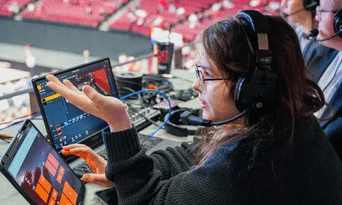
It's 6:45 PM. The game starts in 15 minutes.
One student hasn't shown up. Another forgot their role. The stream isn't live yet, and three people are standing around waiting to be told what to do.
You've been here before. You tell yourself next week will be different.
But it isn't. Because the problem isn't the students.
The Wrong Diagnosis Leads to the Wrong Fix
When game day falls apart, the instinct is to blame people.
The students aren't motivated. They don't care enough. They need more reminders. They need stricter consequences. They need a better teacher.
That diagnosis feels logical. But it's wrong.
Here's what's actually happening: your students don't know what to do without you telling them. Not because they're lazy — because the system was never built to run without you.
There's no checklist they own. No prep process that starts before Friday. No clear accountability when someone drops the ball. Everything depends on one person holding it all together.
That person is you.
And that's a systems problem, not a people problem.
What a Systems Problem Looks Like
You can spot a system's problem by how it behaves.
It shows up every week, not just once. It gets worse when you're absent. It doesn't improve, no matter how many conversations you have with students. And it exhausts you, even when the broadcast technically goes fine.
If any of that sounds familiar, the issue isn't who's on your crew. It's how your program is structured.
Most K-12 broadcast programs run on memory, text messages, and the teacher's ability to anticipate every problem before it happens. That works until it doesn't. Until you're sick on a Friday, or three students cancel at the last minute, or equipment fails, and no one knows the backup plan.
A well-run program doesn't depend on the teacher being present for every decision. It runs because the system was built to handle the predictable chaos of game day.
What Actually Causes Game Day Chaos
There are three root causes. Fix these and game day gets predictable fast.
Unclear roles.
When students don't know exactly what they're responsible for, they wait. They ask. They look around at each other. And when the stream goes live, gaps appear — because no one knew it was their job to cover them.
Clear roles don't just tell a student their title. They tell them exactly what they do, when they do it, and what "done right" looks like. Producer isn't a title — it's a checklist.
Prep that starts on Friday.
Game day chaos is a Monday problem. By the time Friday rolls around, it's too late to catch what's missing.
The programs that run smoothly start game week on Monday. Roles confirmed. Equipment checked. Scenarios walked through. When something breaks on Friday, the response is calm — because the team was already ready.
No accountability without the teacher.
If students only do the work because you reminded them, you're still doing the work. The goal is a crew that holds itself accountable — not because you built a rigid system of consequences, but because the expectations are clear, the jobs feel real, and the standard is visible.
That doesn't happen through motivation. It happens through structure.
What the Fix Actually Looks Like
You're not looking for a perfect crew. You're looking for a system that makes the crew predictable.
Here's the difference:
Without a system, the teacher fills every gap. With a system, students fill the gaps — because the system tells them where the gaps are before they open.
That means written role checklists, not verbal reminders. A prep calendar that runs Monday through Thursday, not a scramble on Friday. A student lead who owns the broadcast, not a teacher who manages it from the sideline.
One teacher described the shift this way: she went from being the one who fixed everything to being the one who coached the person who fixed everything. Same outcome. Completely different dynamic.
That's what structure does. It shifts the work to the students — not because you stepped back, but because you built something they could step into.
The Insight That Changes Everything
Here's the reframe:
Your students don't need more motivation. They need to know exactly what they're responsible for — and that it matters if they don't do it.
That's it. That's the whole thing.
A student who shows up late to a vague role feels bad for a minute and moves on. A student who shows up late to a job with clear expectations — a job the whole broadcast depends on — that student learns something.
Accountability isn't about consequences. It's about stakes. And stakes only exist when roles are real.
When the structure is right, students rise to it. Every time.
Start Here
If your broadcast program feels like it depends on you being in the middle of everything, it does. That's not a reflection of your students — it's a reflection of your structure.
The good news: this is fixable. And you don't have to overhaul everything at once.
Start with one thing. Pick the role that causes the most chaos on game day. Write down exactly what that role requires — from Monday through the moment the stream goes live. Make it specific enough that a student could do it without asking you a single question.
Then hand it off.
That's how programs change. Not through motivational speeches. Through systems.
Ready to build a system your students can actually own?
Or start with the free resource: Download the Broadcast Education Starter Kit
Related reading: How to Start a Student Broadcast Program